
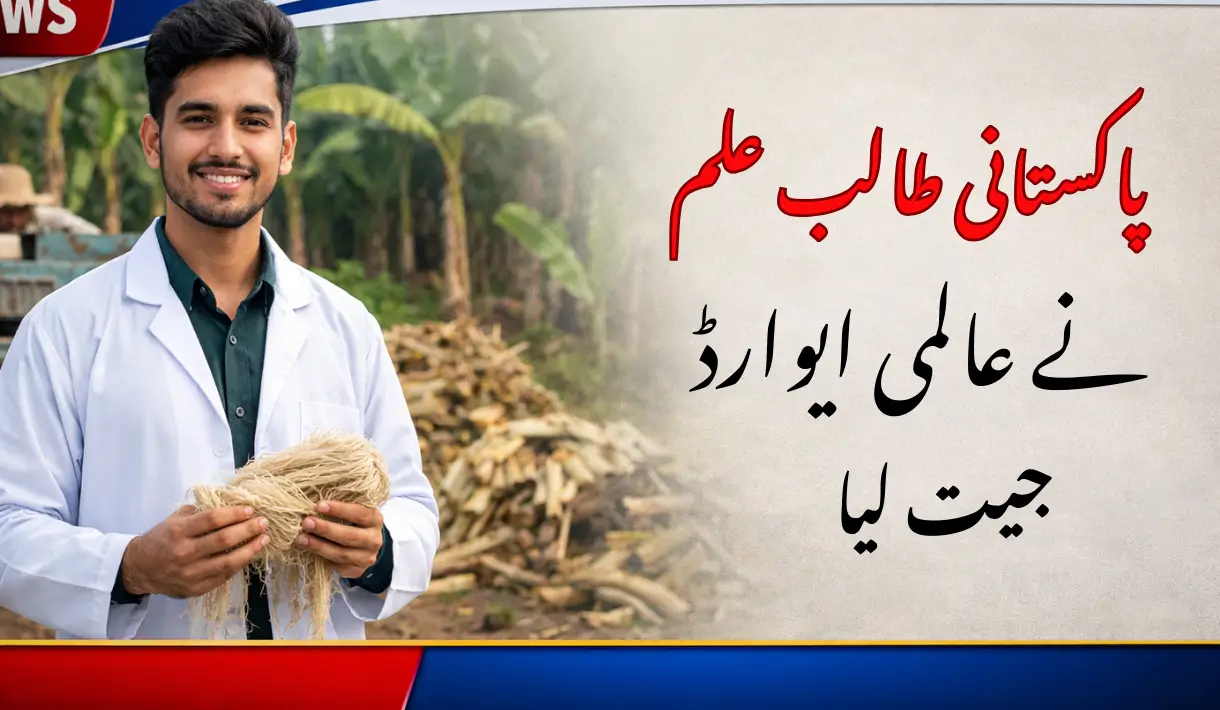
Pakistani Student Wins Global Award for Converting Banana Waste into Eco-Friendly Fiber. A student from Balochistan has brought global recognition to Pakistan through green innovation. He developed a new way to produce natural fiber from banana waste. This breakthrough highlights how local research can solve global sustainability challenges.
Pakistani Researcher Shines at Global Textile Event

Mohammad Sarfraz, a researcher at Balochistan University of Information Technology, Engineering and Management Sciences (BUITEMS), won the prestigious Discover Natural Fiber Initiative (DNFI) Award.
He received the award at the Heimtextil International Exhibition held in Frankfurt.
The competition included over 100 research institutions and companies from across the world. Sarfraz stood out with his method of converting banana stems into high-quality, sustainable fiber.
Turning Banana Waste into Valuable Fiber
Banana farming produces large amounts of agricultural waste. Most of it is burned or dumped. This causes air and water pollution. Sarfraz’s project offers a clean alternative.
His innovation transforms discarded banana stems into usable natural fiber. The fiber can be used in textiles, composites, and other products. The method supports both sustainability and economic growth.
Four Years of Research and Local Innovation
Sarfraz spent four years researching fiber extraction and processing. He worked under the supervision of Dr. Mohammad Qasim, Head of Textile Engineering at BUITEMS.

Dr. Qasim praised the achievement. He said it proves that Balochistan’s youth can compete globally when given proper support and opportunity.
Sarfraz dedicated the award to his teachers and the youth of Balochistan. He also expressed pride in outperforming projects from leading European institutions.
Three-Stage Fiber Production Process
The project follows a clear and scalable production model.
First, fiber is extracted from banana waste.
Second, the fiber is converted into yarn and composite materials.
Third, fabric and finished products are manufactured.
This complete chain makes the project suitable for industrial use.

International Partnerships and Market Interest
Industrial partner Mohammad Fawwad Supriya confirmed strong international interest. Several European companies have shown willingness to collaborate.
A German company has already signed an agreement. It will manufacture and market products made from Pakistani banana fiber. This partnership opens doors for exports and long-term growth.
Job Creation in Sindh and Balochistan
The initiative has strong social impact. Fiber production has already started in Sukkur and Lasbela.
The next phase aims to involve around 4,000 households. This will help create jobs and reduce poverty in rural areas of Sindh and Balochistan.
Low-Cost Machines Designed in Pakistan
Sarfraz also designed low-cost machines locally. These machines support large-scale fiber production.

A unit with two machines costs between Rs700,000 and Rs800,000.
Each unit can produce up to 1,000 kilograms of fiber per acre of banana waste.
This makes the model affordable for small producers and cooperatives.
Pakistan’s Massive Fiber Production Potential
Experts estimate a huge national opportunity. Pakistan can produce nearly 500 million kilograms of natural fiber each year from banana waste.
This has the potential to generate up to one billion dollars in global market value. It can also reduce reliance on synthetic fibers.
Environmental Benefits of Banana Fiber
The project supports environmental protection. It reduces the burning and dumping of banana stems.

This helps lower air pollution and prevents water contamination. It also promotes a circular economy based on agricultural waste.
Benefits of the Banana Fiber Innovation
This innovation offers multiple benefits.
It creates jobs in rural areas.
It reduces environmental pollution.
It adds value to agricultural waste.
It strengthens Pakistan’s textile exports.
It promotes sustainable and eco-friendly production.
Who Can Benefit From This Project
Farmers can earn from banana waste.
Small manufacturers can enter fiber production.
Rural households can gain new income sources.
Textile exporters can access sustainable materials.
Pakistan’s economy benefits from new export streams.
Frequently Asked Questions
What is banana fiber?
Banana fiber is a natural fiber extracted from banana plant stems after harvesting.
Why is banana fiber important?
It is eco-friendly, biodegradable, and reduces agricultural waste.

Where did Sarfraz win the award?
He won the DNFI Award at the Heimtextil Exhibition in Frankfurt, Germany.
How much fiber can one acre produce?
Up to 1,000 kilograms of fiber per acre of banana waste.
Which areas are involved in production?
Production has started in Sukkur and Lasbela, with expansion planned.
Conclusion
Mohammad Sarfraz’s success shows the power of local innovation. His work turns waste into wealth and research into real impact. The banana fiber project proves that Pakistani talent can lead global sustainability efforts when given the right platform and support.