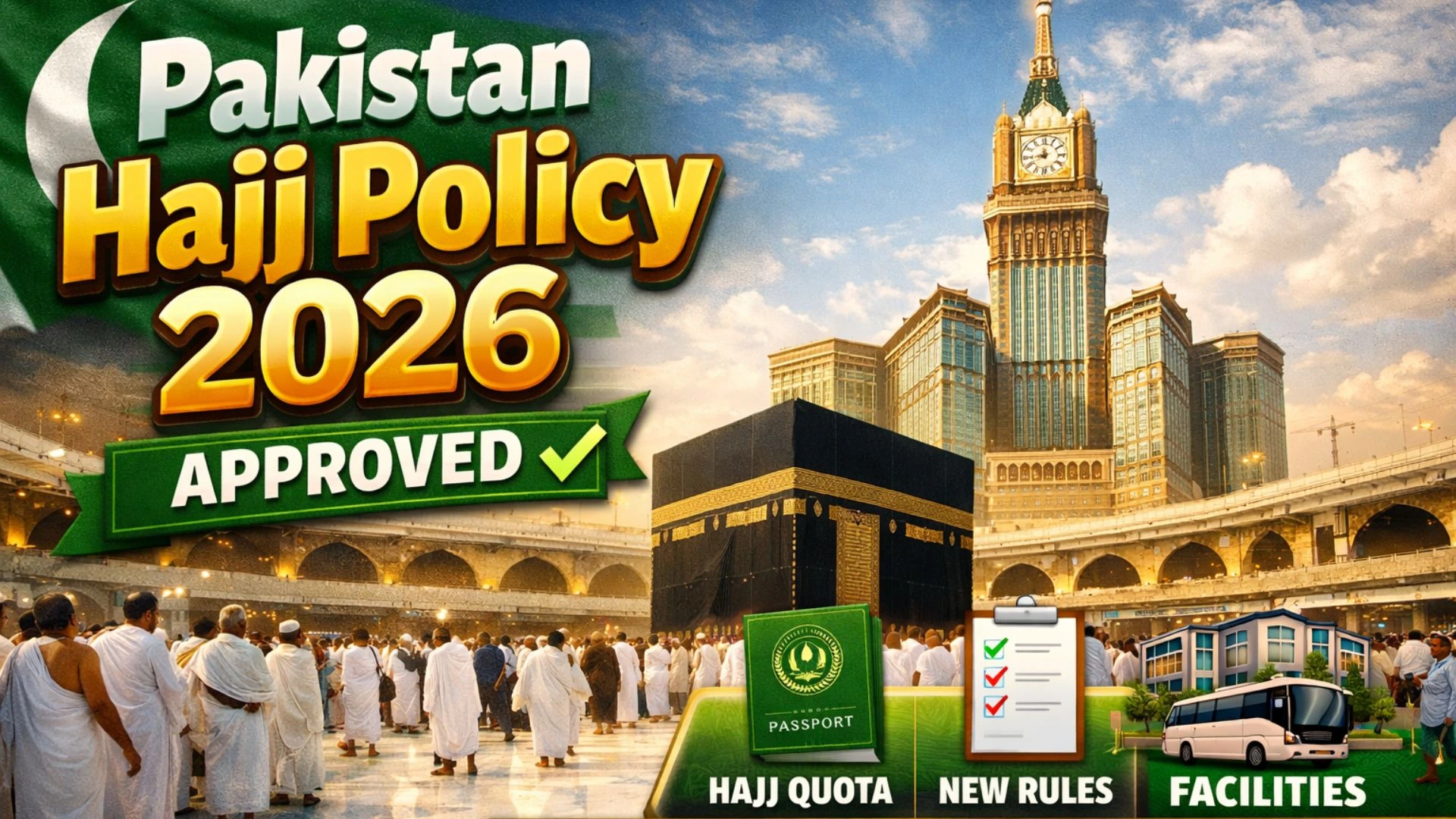
Pakistan Hajj Policy 2026 has officially been approved, bringing clarity and early direction for thousands of Pakistani Muslims planning to perform Hajj next year. The policy aligns national arrangements with Saudi guidelines and focuses on transparency, efficiency, and better facilities for pilgrims.

Having followed previous Hajj policies closely and observed on-ground challenges faced by pilgrims, this early approval is a positive step toward smoother planning, cost control, and service improvement.
Pakistan Hajj Policy 2026: Official Quota Confirmed
Under the newly approved Pakistan Hajj Policy 2026, the government has finalized the national Hajj quota at 179,210 pilgrims.
This confirmation was announced by Sardar Muhammad Yousaf, Federal Minister for Religious Affairs and Interfaith Harmony, following coordination with Saudi Arabia.

Early quota confirmation allows:
- Advance booking and logistical planning
- Better accommodation management in Makkah and Madinah
- Reduced last-minute costs for pilgrims
Government and Private Hajj Quota Distribution 2026
Pakistan Hajj Policy 2026 Quota Breakdown
The approved policy divides the quota between government and private schemes to maintain balance and competition.
Government Hajj Scheme 2026
- Around 120,000 pilgrims
- Subsidized packages
- Government-monitored services
- Preferred by first-time pilgrims
Private Hajj Scheme 2026
- Approximately 60,000 pilgrims
- Operated by licensed private Hajj operators
- More flexibility in packages and accommodation
This structure under Pakistan Hajj Policy 2026 ensures affordability while allowing service upgrades through private competition.

Mandatory Hajj Training Under Pakistan Hajj Policy 2026
One of the most important components of Pakistan Hajj Policy 2026 is mandatory pre-Hajj training for all registered pilgrims.
What the Hajj Training Covers
- Step-by-step Hajj rituals
- Health and hygiene guidelines
- Travel documentation procedures
- Crowd management awareness
From personal observation in previous years, pilgrims who attend structured training face fewer issues during Tawaf, Sa’i, and Mina stay. Making training compulsory significantly improves safety and confidence.
Road to Makkah Facility Expanded in 2026
What Is Road to Makkah Initiative?
The Road to Makkah initiative allows pilgrims to complete Saudi immigration in Pakistan before departure, saving hours at Saudi airports.

Road to Makkah Under Pakistan Hajj Policy 2026
- 38,000 pilgrims to depart via Islamabad
- Currently available in:
- Islamabad
- Karachi
- Expansion planned for Lahore
This facility drastically reduces arrival stress, especially for elderly pilgrims, and reflects Pakistan’s strong coordination with Saudi authorities.
Key Improvements Introduced in Pakistan Hajj Policy 2026
The new policy emphasizes service quality and transparency.
Major Enhancements
- Early policy approval
- Digitized registration and tracking
- Improved coordination with Saudi systems
- Stronger monitoring of private operators
Compared to earlier years, Pakistan Hajj Policy 2026 focuses more on pre-departure preparation rather than reactive management.
Pakistan Hajj Policy 2026 and Interfaith Initiatives
Alongside Hajj arrangements, the government reaffirmed its commitment to interfaith harmony across Pakistan.
Ongoing Religious Affairs Programs
- Scholarships for minority students
- Funding for worship place rehabilitation
- Financial assistance programs
- Reserved representation in public institutions
These initiatives run parallel to Hajj operations, highlighting a broader religious affairs framework.
New Centralized Zaireen Management System
Another major reform announced alongside Pakistan Hajj Policy 2026 is a centralized system for Zaireen traveling to holy sites in Iran and Iraq.

Benefits of the New Zaireen System
- Improved travel coordination
- Enhanced security monitoring
- Reduced agent-related fraud
- Better emergency response
This system aims to bring the same organizational discipline to Ziarat travel that is now standard in Hajj operations.
Why Early Approval of Pakistan Hajj Policy 2026 Matters
Early approval gives pilgrims and operators enough time to prepare financially and logistically.
Key Advantages
- Predictable costs
- Better accommodation selection
- Reduced visa delays
- Improved flight scheduling
From an operational standpoint, this is one of the most organized timelines Pakistan has announced in recent years.
What Pilgrims Should Do Next
If you are planning Hajj under Pakistan Hajj Policy 2026, you should:
- Monitor official registration announcements
- Attend mandatory Hajj training sessions
- Ensure passport validity
- Choose registered private operators only
- Stay updated on Road to Makkah eligibility
Conclusion
Pakistan Hajj Policy 2026 reflects a clear shift toward early planning, pilgrim facilitation, and accountability. With a confirmed quota, improved training, and expanded Road to Makkah facilities, the policy lays a strong foundation for a dignified and well-managed pilgrimage experience.
If implemented with transparency and strict oversight, this policy can significantly improve the overall Hajj experience for Pakistani pilgrims in 2026.